
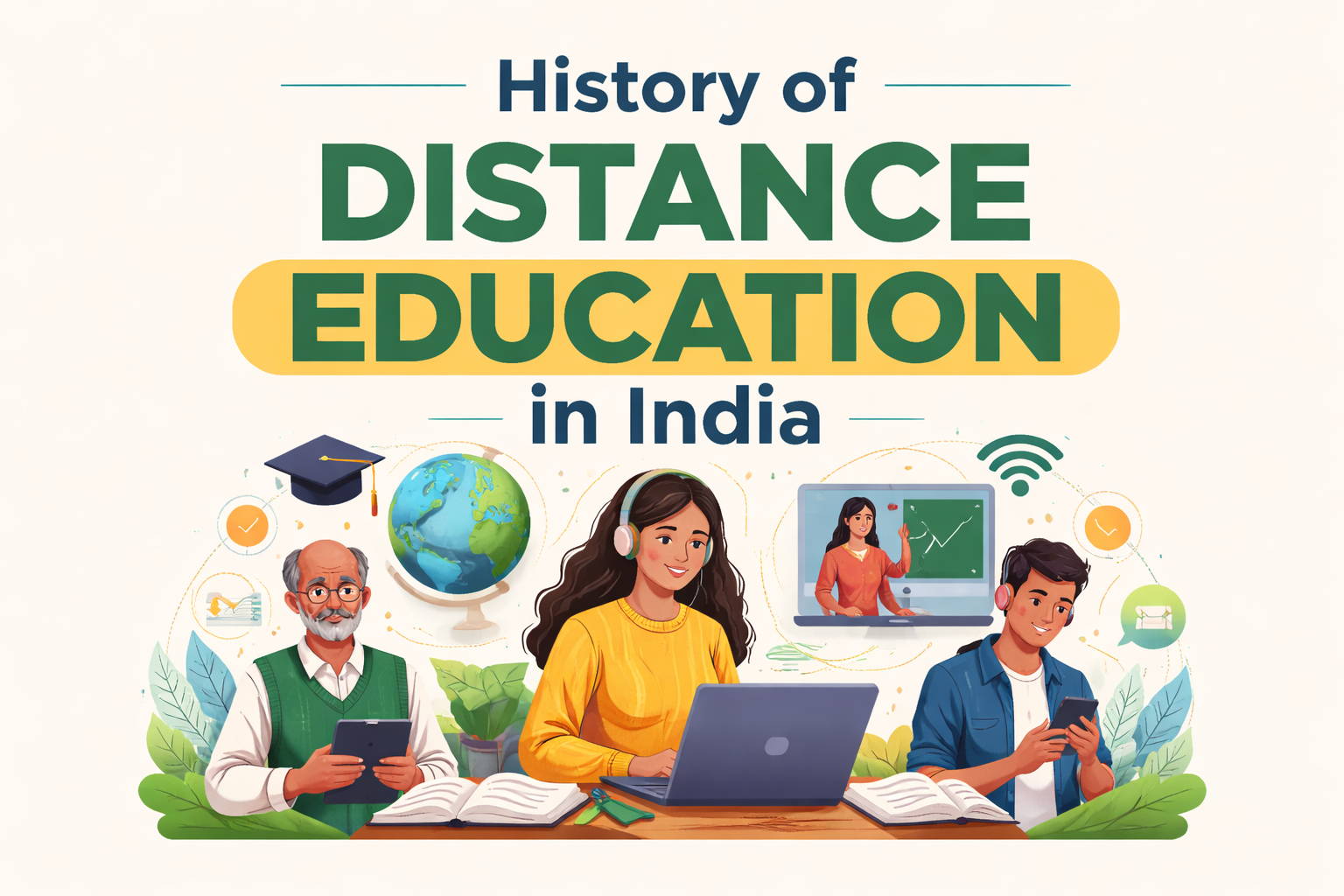
History of Distance Education in India: Growth, Evolution & Future
Distance education in India has transformed the educational landscape by making quality learning accessible to students, working professionals, homemakers, and rural learners. From traditional correspondence courses to modern online degree programs, distance education has opened doors for millions of learners across the country.
In this blog, we explore the history of distance education in India, its development, major milestones, benefits, and future opportunities.
What is Distance Education?
Distance education is a mode of learning where students study remotely without attending regular physical classes. Study materials, online lectures, recorded sessions, assignments, and examinations are conducted through postal, digital, or virtual methods.
This flexible system is ideal for:
- Working professionals
- Housewives and homemakers
- Rural students
- Students preparing for competitive exams
- Learners seeking affordable higher education
History of Distance Education in India
The history of distance education in India began during the early 1960s when universities introduced correspondence courses for students unable to attend regular classes.
1. Beginning of Correspondence Education (1960s)
The University of Delhi launched the School of Correspondence Courses in 1962, becoming one of the first institutions to offer structured distance learning in India.
This was a revolutionary step in Indian higher education, allowing students to pursue degrees from home.
2. Expansion Phase (1970s–1980s)
During the 1970s and 1980s, many Indian universities started correspondence education departments.
Popular universities included:
- University of Madras
- University of Mumbai
- Punjab University
- Annamalai University
These universities helped thousands of students complete graduation and post-graduation through distance mode.
3. Birth of Open Universities (1980s)
A major turning point came in 1982 with the establishment of Dr. B.R. Ambedkar Open University, India’s first open university.
Later in 1985, the Government of India established Indira Gandhi National Open University (IGNOU).
IGNOU became one of the world’s largest open universities and revolutionized distance learning through:
- Undergraduate Programs
- Postgraduate Degrees
- Diplomas
- Certificate Courses
- Professional Courses
Growth of Distance Education in India
During the 1990s and 2000s, several state open universities were established, including:
- Yashwantrao Chavan Maharashtra Open University
- Karnataka State Open University
- Nalanda Open University
- Tamil Nadu Open University
This period saw massive enrollment growth among working adults and rural students.
Digital Transformation of Distance Education
With the rise of the internet, distance education in India moved from printed study materials to digital platforms.
Today, students can access:
- Online classes
- E-books
- Video lectures
- LMS portals
- Online assignments
- Virtual exams
Many UGC-approved universities now offer fully online degree programs.
Benefits of Distance Education in India
Distance learning offers multiple advantages:
Flexible Learning
Students can study anytime, anywhere.
Affordable Education
Fees are lower compared to regular college programs.
Career Growth
Working professionals can upskill while continuing jobs.
Wider Access
Students from villages and remote areas can pursue higher education.
Challenges of Distance Education
Despite progress, some challenges remain:
- Lack of awareness
- Internet connectivity issues
- Need for practical training in some courses
- Recognition concerns for fake institutions
Future of Distance Education in India
With NEP 2020, digital India initiatives, and growing acceptance of online learning, the future of distance education in India is highly promising.
Upcoming trends include:
- AI-based learning
- Hybrid education models
- Skill-based online certifications
- Industry-integrated courses
- Global online degree access
Conclusion
The history of distance education in India reflects the nation’s commitment to inclusive and accessible learning. From correspondence education in the 1960s to modern online universities, distance education continues to empower millions of students.
If you are looking for flexible, affordable, and career-focused education, distance learning is one of the best options in today’s world.